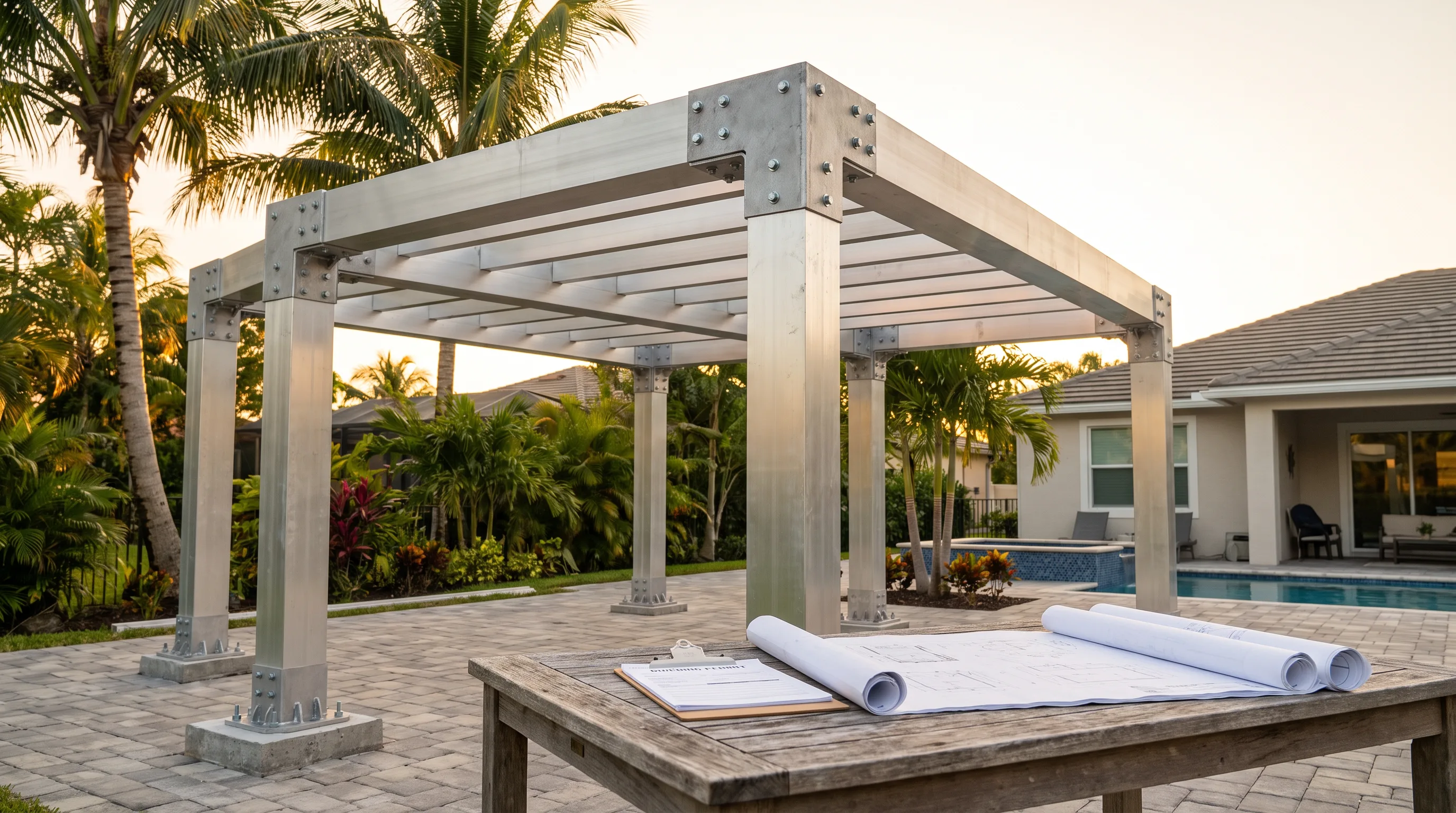
Broward County pergola permit requirements
Yes — most Broward County municipalities require a building permit for a permanent pergola, including engineered drawings that demonstrate compliance with Florida Building Code wind-load requirements. A licensed contractor typically handles the application, plan review, and inspections for you.
Broward County sits in one of the highest wind-load zones in Florida, so local building departments take pergola permitting seriously — this isn't a jurisdiction where you can casually bolt a structure to your patio and hope nobody notices. Here's what the process actually involves, in plain terms.
Why pergolas need a permit in Broward County
A pergola is a permanent structure attached to or anchored on your property, which puts it under the same Florida Building Code wind-load provisions as carports, screen enclosures, and other accessory structures. Broward's design wind speeds — driven by its hurricane exposure — mean inspectors specifically check anchor bolt sizing, footing depth, and beam spans against engineered calculations, not general "good practice."
What the permit process looks like
1. Design and engineering
Your contractor or a licensed engineer produces sealed drawings showing the pergola's dimensions, materials, connection details, and footing design rated for Broward's wind zone.
2. Application and plan review
The permit application, along with a site plan and the engineered drawings, goes to your city's building department (Fort Lauderdale, Davie, Weston, Plantation, Coral Springs, and other Broward municipalities each run their own review, though timelines are broadly similar).
3. Plan review turnaround
Expect roughly 3-6 weeks for initial review in most Broward cities, though this varies with each department's current volume — some jurisdictions move faster for straightforward residential accessory structures.
4. Installation and inspection
Once the permit is issued, installation on a standard residential pergola generally takes 1-3 days on-site. An inspector then reviews the completed footings and structural connections before the permit is closed out.
- Engineered drawings are required, not optional, for permanent structures
- HOA approval is a separate step from county/city permitting
- Anchor and footing specs must match your specific wind-exposure category
- A final inspection is required to legally close the permit
Skipping the permit is a bigger risk than it looks
Beyond code-enforcement fines, unpermitted structures frequently surface during a home sale — buyers' inspectors and title companies routinely flag them, which can delay or derail a closing. Retroactive permitting an existing structure is often more expensive and slower than doing it right the first time.
Who's responsible for pulling the permit?
A licensed general contractor typically pulls the permit under their own license, which means the completed structure is tied to their liability coverage and warranty. If you're comparing bids, ask directly whether the quoted price includes permitting, engineering, and inspection coordination, or whether those are billed separately — it's one of the most common places quotes diverge. Our Broward County pergola installation page outlines exactly how we scope and handle this for local homeowners.
Frequently asked questions
Do I need a permit to build a pergola in Broward County?
Yes. Most Broward County municipalities require a building permit for a permanent, structurally-attached pergola, including engineered drawings showing compliance with Florida Building Code wind-load requirements. Small, freestanding kits under certain size thresholds may have different rules by city, so it's worth confirming with your local building department.
How long does it take to get a pergola permit approved in Broward County?
Permit review timelines in Broward County typically run 3-6 weeks depending on the municipality and current plan-review backlog, though some cities process straightforward residential accessory-structure permits faster.
What happens if I build a pergola without a permit in Florida?
An unpermitted pergola can result in code-enforcement fines, a stop-work order, and complications at resale, since unpermitted structures often must be disclosed and can require retroactive permitting or removal before closing.
Who pulls the permit — me or the contractor?
A licensed contractor typically pulls the permit under their license, which also means the completed work is tied to their liability and warranty. Ask before signing whether permitting is included in your quote.
Does an HOA approval replace the need for a county permit?
No. HOA architectural approval and county/municipal building permits are separate processes — you generally need both, and HOA approval does not substitute for code compliance or permit issuance.
For a deeper look at wind-load engineering itself, see our guide on hurricane-proofing your pergola and understanding wind ratings. And if you're comparing what different structures cost once permitting is included, read our 2026 South Florida pergola cost guide.
Let us handle your Broward County permit, start to finish
We prepare the engineering drawings, file the permit, and coordinate every inspection with your municipality — so you don't have to navigate the building department yourself.